
HYDROGEN BEYOND BORDERS – 1
Editor’s Note
Recent developments, including the West Asia conflict, have added urgency to hydrogen production to meet growing energy requirements.
Countries across trade corridors are building production, logistics, demand and finance ecosystems.
In part one of Hydrogen Beyond Borders, AfroAsian News discusses how the green hydrogen economy is beginning to take shape beyond national boundaries and tracks its evolution.
The hydrogen story is moving
In its early phase, the hydrogen story centred largely on national priorities.
Governments announced production targets, outlined incentives, and positioned it within domestic energy transition strategies.
India’s National Green Hydrogen Mission reflects this approach—linking renewable energy capacity with industrial ambition.
But the industry does not remain confined within national boundaries.
As projects move from announcement to execution, it is becoming clear that production, transport, demand, and finance are distributed across regions.
The hydrogen economy is moving beyond self-contained national systems but towards interlinked structures that extend across borders.
The hydrogen economy will be built not by production alone, but by connecting production, infrastructure, finance and demand across borders.
A New Geography Taking Shape
Hydrogen decouples energy production from ultimate consumption.
Resource-rich regions are becoming production bases. Industrial economies are shaping long-term demand.
Capital is flowing from yet another set of geographies. These roles do not align neatly within a single country.
A new pattern is emerging. India’s engineering and manufacturing capabilities, West Asia’s capital and project scale, and Africa’s renewable potential are complementing one another.
Hydrogen, in this sense, is no longer only an energy transition. It is becoming a question of trade, industry, and cross-border alignment.
Capacity Is Not Enough
Much of the current discussion is focused on capacity—electrolysers, production targets, and early-stage projects.
These developments are necessary. But they are not sufficient. The real challenge lies in connecting production with demand.
In practice, hydrogen rarely moves as a gas. It is converted into carrier molecules such as ammonia or methanol, each requiring dedicated storage, handling, and conversion systems.
Recent developments reinforce this trend. Methanol is now being tested for transport through existing refined-product pipeline infrastructure in China.
The challenge is no longer only to produce hydrogen, but to build the systems through which it can move reliably across geographies.
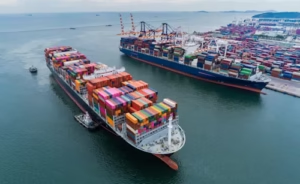
Port infrastructure, logistics networks, and downstream integration form the key nodes where conversion and deconversion are taking place.
Ports, vessels, offtake arrangements, and supply systems move on their own.
Producing hydrogen is no longer the only challenge. It is an arduous path to build the systems through which hydrogen can move reliably across geographies.
Where Projects Slow Down
Technology is advancing, costs are declining, and commercial opportunities are becoming clearer.
Yet project execution remains uneven. The constraint is not technology. It is the structure.
Across the value chain, projects struggle to align three critical elements at the same time:
* Assured offtake
* Workable pricing
* Committed volumes
The industry is discussing these constraints, highlighting the need for financing frameworks, certification standards, and long-term contracts.
But these issues are often addressed separately, rather than as part of a single, integrated structure.
The result is a gap between announcements and financial closure. When these factors come together, projects move. When they do not, progress slows.
From Announcement to Agreement
The Industry is beginning to address this gap.
The long-term green ammonia agreement between India’s Larsen & Toubro and Japan’s ITOCHU Corporation—structured on a take-or-pay basis—marks a shift from intent to execution.
It links production with assured demand, reduces uncertainty across the value chain and facilitates financing.
Such projects are limited because they are structured in a different way where contractual agreement precedes scale.
Building Demand Systems
Europe is witnessing a similar shift.
Germany is advancing plans to repurpose parts of its existing natural gas network for hydrogen, creating cross-border connections between industrial clusters.
The emphasis is not on production alone, but on generating demand within a coordinated infrastructure.
In effect, production can be located elsewhere, while consumption is structured domestically.
Hydrogen is beginning to take shape not as a standalone fuel, but as a network—linking pipelines, ports, industrial users, and long-term contracts.
Scale Requires Repeatability
Large projects are being announced. Capacity is expanding.
But scale without repeatability does not translate into sustained growth.
The more critical question is whether projects can be replicated—across locations, and with similar structures, similar risk allocation, and consistent delivery.
If every project is structured differently, capital hesitates. Capital flows when projects follow a recognisable pattern,
The issue is no longer whether the industry can build such projects. The real question is whether it can repeat them at scale.
Where This Leads
The system is still taking shape.
Supply chains are evolving. Partnerships are not yet fixed. It is, in effect, still in motion.
It will not scale through production capacity alone. It will scale through alignment—between policy, capital, infrastructure, and industry—across borders.
However, such integration is still incomplete. It is within this gap, between policy signals and system-level execution, that the next phase will be determined.