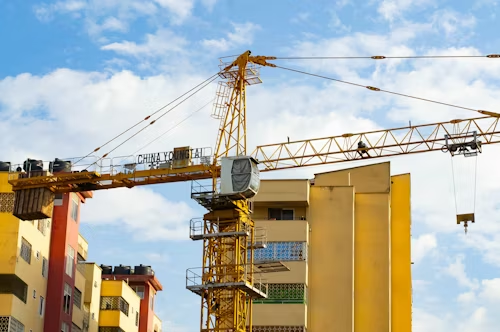
East Africa is entering a pivotal phase in its construction and infrastructure evolution. Across Kenya, Rwanda, Tanzania, and Uganda, a powerful blend of digital permitting systems, modular construction technologies, and cross‑border workforce mobility is redefining how cities expand, repair, and modernise their built environments. The result is a rapidly emerging digital construction economy that is faster, cleaner, and more resilient than traditional brick‑and‑mortar practices. Urbanisation in East Africa is accelerating faster than most policy frameworks were designed to manage. Nairobi alone absorbs over 200,000 new residents every year, while Dar es Salaam is projected to become one of the world’s largest metropolitan areas by 2050. This surge has strained housing pipelines, road networks, utilities, and public facilities. Governments increasingly recognise that conventional construction timelines are incompatible with current demographic pressures. Modular and prefabricated construction techniques are now being deployed at scale. Prefab components such as steel frames, insulated wall panels, and fully finished room modules are manufactured in controlled factories and transported to sites for rapid assembly. This approach reduces construction timelines by 40–60%, lowers labour requirements, and dramatically cuts material waste. Rwanda’s Bugesera Special Economic Zone has emerged as a regional leader in producing high‑precision prefab elements used in both residential and commercial developments. Kenya has integrated modular construction into its Affordable Housing Programme, enabling large housing estates to be completed in months rather than years. Some firms are piloting 3D‑printed building components, further reducing costs and accelerating timelines. This combination of automation, digital design, and prefabrication has made East Africa one of the world’s fastest‑adopting regions for construction technology. Digital permitting systems form the second major pillar of the region’s transformation. Kenya’s e‑Construction Permit System has reduced approval cycles from 30–60 days to as few as 5–10 days for compliant applications. The system provides transparent fee structures, automated zoning checks, and real‑time status updates, while reducing opportunities for bureaucratic delays.
Construction‑management apps are increasingly used to synchronise procurement orders, worker shifts, site inspections, and equipment allocations. Drone‑based surveys have become standard for monitoring progress on large projects and enhancing worker safety. Tanzania and Uganda are now piloting similar platforms, especially for mixed‑use developments requiring multilayer permits. Another defining trend is the rise of cross‑border construction labour mobility in the East African Community (EAC). Skilled engineers, BIM specialists, surveyors, and prefab assembly experts routinely rotate between Kenya, Rwanda, Tanzania, and Uganda due to simplified labour regulations. Kenya and Rwanda have become regional talent hubs for digital surveying and site automation, while Tanzania supplies skilled heavy‑machinery operators. Environmental sustainability is embedded in the new construction wave. Factory‑made prefab components produce up to 70% less waste than traditional construction. Many modules incorporate eco‑friendly materials such as recycled steel, bio‑based insulation, and thermally efficient coatings. Digital permitting platforms assist environmental agencies by flagging projects located in sensitive zones and verifying environmental‑impact compliance. Despite progress, challenges remain. Prefab factories require significant upfront investment, meaning adoption is faster among larger firms than smaller contractors. Transportation of oversized prefab elements depends on improved highway infrastructure. Workforce development lags in specialised areas such as robotics‑aided construction and advanced BIM design. Nonetheless, the economic momentum and policy support behind the digital construction boom remain strong. East Africa’s emergence as a construction‑tech frontier illustrates how digital transformation, modular innovation, and regional workforce integration can reshape urbanisation trajectories. As demand for infrastructure accelerates, the region’s modernised construction model could become a blueprint for other rapidly urbanising regions across the Global South.