

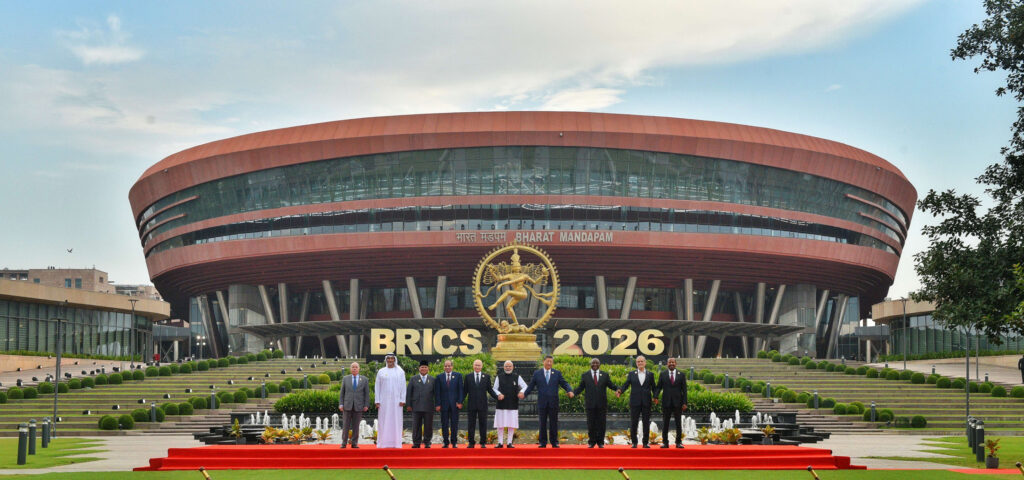
The Summit Charts Course for Equitable Global Governance and Structural Economic Integration
The 18th BRICS Summit in New Delhi marks a pivotal consolidation of India’s dual role as a pragmatic bridge between competing geopolitical blocs and a principal advocate for the Global South. Holding the BRICS Chair, India has focused on translating broad anti-hegemonic rhetoric into functional, institutionalised mechanisms. Rather than positioning the grouping purely as an opposition to Western platforms, New Delhi’s strategy emphasised building complementary financial, technological, and developmental structures that offer developing nations actionable options in an increasingly multi-polar global economy.
Macroeconomic Weight & Intra-Bloc Trade Dynamics
With its expanded membership, the BRICS grouping represented approximately 49.5% of the world’s population (Source: BRICS 2026 Official Secretariat) and over 44% of global GDP on a Purchasing Power Parity (PPP) basis (Source: IMF World Economic Outlook), comfortably exceeding the output of the traditional G7 countries. Instead of remaining a purely diplomatic umbrella, intra-BRICS commercial engagement has deepened significantly, driven by bilateral trade momentum and supply chain integration.
Surging Export Footprint: India’s export volume to the four core BRICS founding partners (Brazil, Russia, China, and South Africa) grew 34% year-over-year to $19.9 billion during April–August FY26 (Source: Ministry of Commerce and Industry, Government of India). This demonstrates the growing importance of intra-bloc trade,
Expanding Export Share: Core BRICS partners now absorb 9.2 % of India’s total global exports, up from 8.1% in the corresponding period of the previous fiscal year (Source: Ministry of Commerce and Industry, Government of India).
Bilateral Trade Anchors: Indian exports to China expanded by 39% to reach $9,6 billion in the first five months of FY26 mainly driven by industrial raw materials, electronics, and energy commodities. Shipments to South Africa recorded the fastest growth among member nations, surging by 58% (Source: Ministry of Commerce and Industry, Government of India).
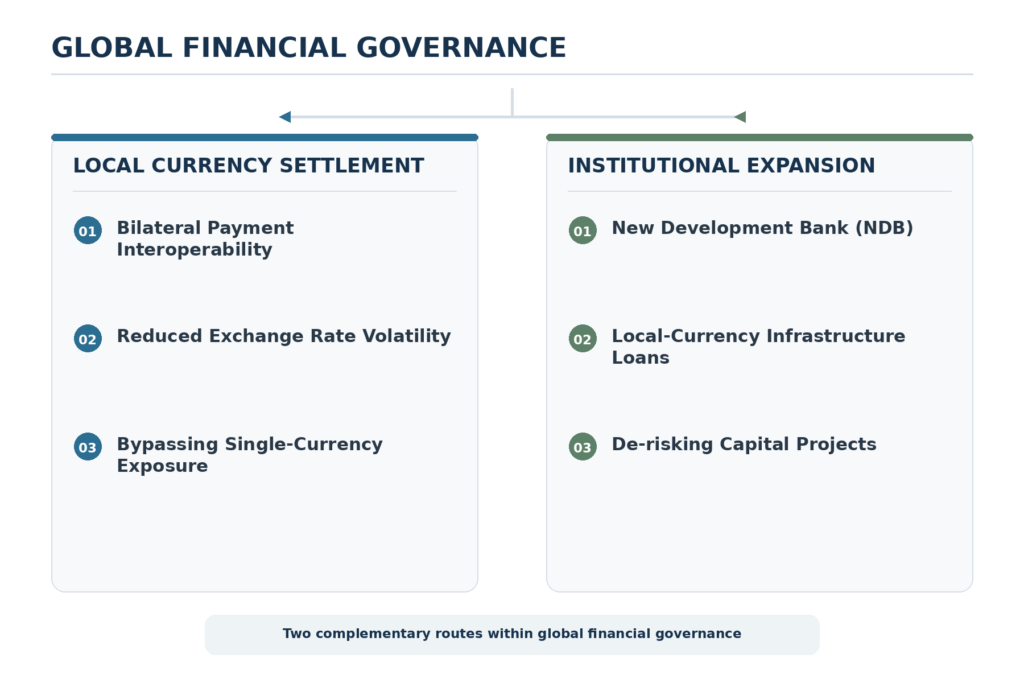
Local Currency Settlement Mechanisms: A central focus at the summit was expanding trade settlement using national currencies to lower reliance on single-currency international clearing systems. By establishing standardised cross-border payment interoperability, member states aim to reduce transaction fees and shield emerging markets from exchange-rate volatility.
Capitalising the New Development Bank (NDB): The summit reinforced the role of the NDB as a primary catalyst for sovereign infrastructure financing. Expanding local-currency lending through the NDB enables developing nations to finance green transitions and logistics corridors without accumulating foreign currency risk.
Institutionalising the Global South Agenda
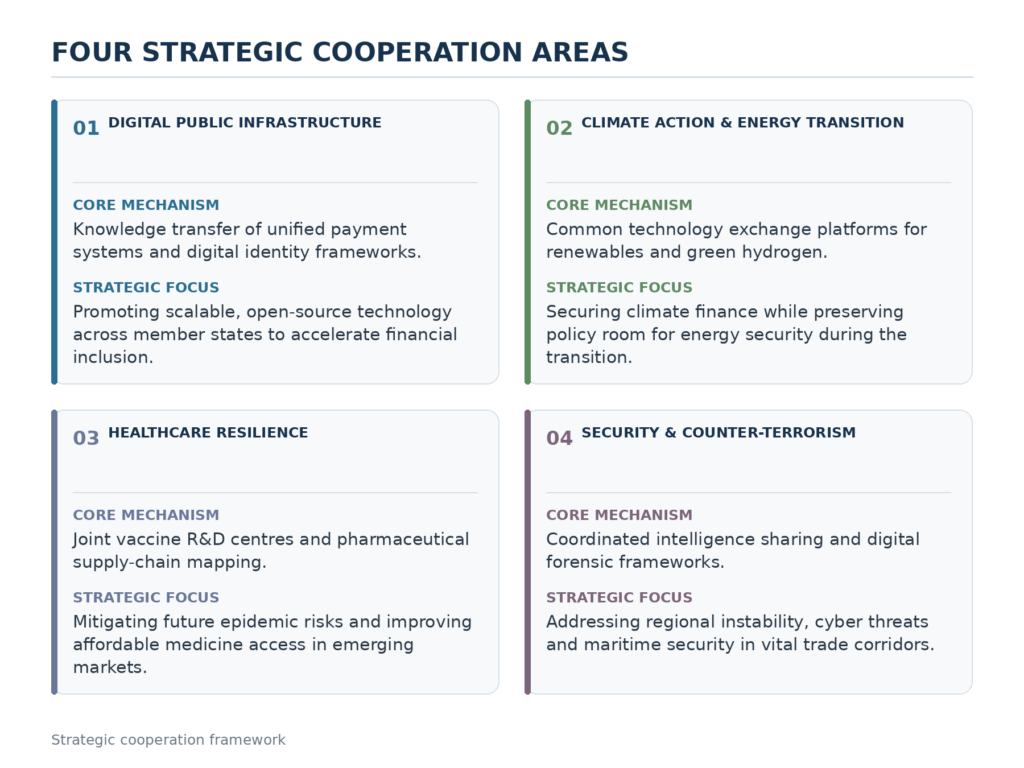
Rather than acting strictly as a counterweight to Western institutions, India’s diplomatic strategy within BRICS used the platform to reform multilateral governance from within. By leading discussions on institutional expansion and sectoral cooperation, New Delhi has framed the Global South’s priorities around concrete deliverables:
Calibrated Expansion & Multi-Alignment Diplomacy
India’s leadership during the 18th BRICS Summit underscored a consensus-driven approach to expanding membership. By establishing clear criteria for partner states, India ensured that expansion strengthens the group’s economic cohesion while maintaining its non-aligned character.
India demonstrated how multi-alignment can be leveraged to shape global norms and insulate its domestic economy from severe external shocks by balancing strategic partnerships with Western economies alongside its leading role in BRICS.
In the immediate backdrop of acute global trade disruptions, volatile maritime security in key choke points and heightened energy insecurity stemming from the conflict and the Hormuz shipping disruptions, India’s pragmatism provided a crucial buffer.
India has sought to mitigate supply chain risks by securing alternative energy supply routes and building local-currency settlement frameworks through BRICS while keeping open diplomatic and trade channels. The 18th BRICS Summit confirms that India’s vision for BRICS is not focused on bloc confrontation, but on constructing a more resilient, democratic, stable, and equitable global architecture capable of weathering geopolitical crisis.
The Multi-polar Alignment
Challenging Washington’s Hegemony
By K P Fabian, Former Ambassador
The 18th BRICS summit chaired by Prime Minister Modi was attended by the 11-member BRICS in full force. The presence of China’s President Xi Jinping, Russia’s President Putin, and Iran’s President Pezeshkian drew much attention from the media. All of them had bilateral meetings with the host.
Xi Jinping was in India for the first time after 2019. The 2020 Galvan incident at the border had strained bilateral relations for a while. It is only recently that the two Asian giants decided to start restoring trade and investment relations without waiting for a resolution in full measure of the differences over the border. India with a burgeoning trade deficit – $112.16 billion in 2025-26- needing a set of essential ingredients from China for manufacturing a variety of products needed to take this decision.
However, it is not certain that just because of this summit level meeting the road ahead is going to be smooth. The Pakistan-China Boundary Joint Commission met in Islamabad on 16-17 September and India’s Ministry of External Affairs promptly asserted that it was “illegal” as there is no boundary between the two. It is the Pakistan-Occupied Kashmir and Pakistan’s decision to part with a slice of territory to China in 1963 that created this boundary.
China had put out a warning before the Commission met. Foreign Minister Wang Yi had said that there should be “ no stagnation or backsliding” after the two countries have reached “an important consensus.”
Putin has made it clear that Russia wants to strengthen and deepen ties with India with focus on trade, energy, and defence. India is responding rather enthusiastically to Russia’s courting.
We mentioned these two bilateral meetings because a multilateral meeting provides an opportunity for important bilateral meetings which are not mentioned in the joint communique, known as the Delhi Declaration- over 17,850 words- in this case.
That a declaration was agreed to despite deep disputes among Iran, the United Arab Emirates, and Saudi Arabia is a tribute to the Indian Sherpa Sudhakar Delela (Sheikh Secretary, Economic Division) and Sous Sherpa Joint Secretary Shambu L. Hakki. However, it is also patent that none of the three countries would have wanted to be seen as standing in the way of a declaration. The Crown Prince of Abu Dhabi, Sheikh Khaled bin Mohamed bin Zayed Al Nahyan did meet with President Pezeshkian.
There were two elephants in the room, a big one, Trump, and a small, shrinking one, Netanyahu.
How did the drafters of the declaration take care of the two elephants? Trump or America was never mentioned by name though the message was clear. “We condemn the imposition of unilateral coercive measures are contrary to international law, and reiterate that such measures, inter alia in the form of unilateral economic sanctions and secondary sanctions, have far-reaching negative implications for the human rights, including the rights to development, health and food security, of the general population of targeted states, disproportionally affecting the poor and people in vulnerable situations, deepening the digital divide and exacerbating environmental challenges. We call for the elimination of such unlawful measures, which undermine international law and the principles and purposes of the UN Charter. We reaffirm our opposition to unilateral coercive measures that are contrary to international law and the Charter of the United Nations, including non-UN Security Council authorized sanctions.”
Israel is named. “We welcome the ceasefire in Lebanon and call on all parties to strictly adhere to its terms and to fully implement UNSC Resolution 1701. We condemn the continued violations of the ceasefire and of the sovereignty and territorial integrity of Lebanon. We call on Israel to respect the terms agreed with the Lebanese government and to withdraw its occupying forces from all of the Lebanese territories, in which they remain.”
Impact on geopolitics and geoeconomics
Will the Delhi Declaration have any impact on geopolitics and geoeconomic? This started a rapprochement in 1971 by sending Henry Kissinger to Beijing, starting a process eventually leading to China’s entry into the WTO in 2001, enabling it to embark on an export-led growth trajectory to become next to the U.S. Therefore, population size per se does not translate into economic or political power.
The BRICS accounts for roughly for 40% of world GDP, measured in PPP (Purchasing Power Parity} terms as contrasted with G7’s 28%. This comparison is more important than apparent. Because, with Trump imposing tariffs on the G6, there is no G7.
However, it cannot be denied that BRICS lacks a secretariat and is rich in plans and projects not always followed through. It made sense for the summit to avoid any talk of de-dollarisation per se as Trump gets irritated by any such talk. As a matter of fact there is no question of any common currency for BRICS for two obvious reasons. First, out of the total nominal GDP of $34 trillion, China accounts for $20 trillion. It follows that if there is a common currency, the BRICS central bank will be in China. Second, will India and others agree to abdicate their financial sovereignty?
What is practical is increased trade settlement in national currencies as Russia and China have been doing. In fact, settling in national currencies is not a BRICS invention. India and the Soviet Union have been doing it since 1973. BRICS is primarily an effort to dismantle the hegemony of Washington. A situation that has taken a vicious form under Trump and that effort will and should continue. Trump himself is helping by destabilising the G7 as mentioned.
Incidentally, China will be taking over as chair next year, which is known there as the Year of the First Goat.


