Introduction
For much of the post-war era, the U.S. dollar has reigned as the world’s primary reserve and trade currency. Its dominance shaped the global financial architecture and gave the United States disproportionate influence over international commerce.
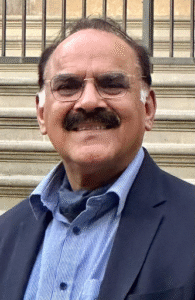
But today, across Africa and Asia, a new movement is questioning the logic of dollar dependence. In this insightful interview, Dr. Arvind Mayaram, former Finance Secretary of India and a veteran of global economic diplomacy, explains the forces behind de-dollarisation, the role of BRICS, and the innovations reshaping global trade.
Q&A with Dr. Arvind Mayaram
Q1. Why has the U.S. dollar enjoyed such dominance in global trade and finance for so long?
A1. For decades, the U.S. dollar was the backbone of the post-war financial order. As the primary reserve and trade currency, it provided stability, liquidity, and influence, reinforcing America’s central role in international commerce. But today, many countries are reassessing this reliance.
Q2. What is driving the current wave of de-dollarisation?
A2. The shift is both economic and strategic. The U.S. has increasingly weaponised the dollar, using sanctions on countries such as Iran, Russia, and Venezuela to enforce geopolitical influence. These actions, executed via dollar-clearing networks and SWIFT, have exposed vulnerabilities in monetary dependence and spurred nations to seek alternatives.
Q3. What role is BRICS playing in this trend?
A3. BRICS has become a central force. Once a five-nation bloc, it now includes Egypt, Ethiopia, Iran, the UAE, and Indonesia—with others like Malaysia and Nigeria in discussion.
At the 2023 Johannesburg BRICS Summit, leaders committed to:
-
Expanding trade in local currencies.
-
Exploring a joint settlement currency, potentially backed by a basket of BRICS currencies and commodities such as gold.
This reflects the momentum for multipolar finance.
Q4. How are major players like China, Russia, and India responding?
A4.
-
Russia has redirected energy exports into RMB and rupee contracts.
-
China is promoting the RMB via 30+ bilateral swap agreements and expanded Gulf trade usage.
-
India is cautious but has signed rupee-settlement deals with Sri Lanka, Russia, and Mauritius. In 2023, the RBI allowed 18 nations to open rupee Vostro accounts, enabling direct trade without the dollar.
Q5. What innovations are emerging in Africa?
A5. Africa is not passive—it’s innovating boldly:
-
Nigeria launched the eNaira (a CBDC).
-
Egypt and South Africa are developing digital currency platforms.
-
The Pan-African Payment and Settlement System (PAPSS) seeks to unify intra-African trade.
-
The UAE has settled energy trades with China in yuan and joined Project mBridge, a multi-nation CBDC pilot.
These signal a new Afro-Asian confidence in building systems beyond Western control.
Q6. Are there experiments with alternative instruments?
A6. Yes. Examples include:
-
Zimbabwe’s gold-backed digital token.
-
Russia and Iran reportedly working on a gold-pegged stablecoin for bilateral trade.
These highlight a willingness to challenge traditional monetary models.
Q7. What are the biggest challenges to de-dollarisation?
A7. Three major challenges:
-
Financial depth & liquidity – U.S. markets remain unmatched.
-
Regulatory harmonisation – different rules in forex, AML, and digital currencies create risks.
-
Political & institutional credibility – investors are wary of currencies from inflation-prone or unstable states.
Currently, while 46% of global trade is invoiced in non-dollar currencies, true dollar-free settlements remain small. Systems like China’s CIPS, Russia’s SPFS, and BRICS Pay are still in early stages.
Q8. How might U.S. policy—for example, under Donald Trump—impact these efforts?
A8. Aggressive U.S. rhetoric or sanctions will accelerate de-dollarisation. Trump has previously threatened BRICS and other initiatives. Such actions deepen mistrust and push countries to collaborate more closely on alternative systems, potentially fragmenting the global monetary order.
Q9. What does the future of global finance look like?
A9. The future won’t be about replacing the dollar with a single new hegemon. Instead, it will be plural and multipolar—a mosaic of regional currencies, digital instruments, and bilateral trade settlements.
The unipolar era of money is fading, and Africa and Asia are emerging as architects of a new financial order.
About the Expert
Dr. Arvind Mayaram is a former Finance Secretary of India, India’s finance deputy at the G20 and BRICS, and co-chair of the G20 Framework Working Group. He has represented India at the World Bank, ADB, AfDB, and was chief negotiator for the BRICS New Development Bank.
Currently, he chairs the Institute of Development Studies, Jaipur, and contributes extensively to journals and policy platforms.