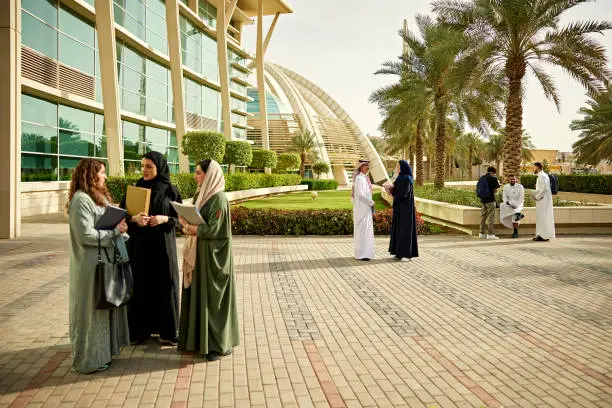
The Middle East is rapidly emerging as one of the world’s most dynamic education hubs, driven by ambitious national visions, global talent initiatives, and deepening academic partnerships with Asia. As Gulf countries invest heavily in universities, vocational training, and research ecosystems, Asian institutions—particularly from India, Singapore, China, and South Korea—are becoming central to this transformation.
A Shift Toward Knowledge Economies
GCC economies are undergoing structural shifts that place education and human capital at the centre of development. Saudi Arabia’s Vision 2030, the UAE’s Centennial Plan, and Qatar’s National Vision 2030 emphasise diversification, innovation, and advanced skills. These goals are driving a wave of collaboration with Asian universities known for STEM excellence, digital education, and technical training.
For Asia, the Middle East represents a fast-growing market with strong demand for skilled professionals, vocational trainers, and university partnerships. The result is a mutually reinforcing system: Gulf nations gain capacity-building support, while Asian countries expand their soft-power and educational footprint.
University Partnerships and Branch Campuses
The expansion of international branch campuses in the Gulf has been one of the region’s most significant trends. While Western universities once dominated this space, Asian institutions are now taking a prominent role. Indian Institutes of Technology (IITs), Singaporean universities, and leading Chinese and Korean institutions are collaborating with Gulf governments to establish engineering, AI, and business programs.
Joint campuses in the UAE and Saudi Arabia are offering dual-degree pathways and industry-centred curricula aligned with local labour market needs. These partnerships reflect a shift toward practical, innovation-driven learning rather than traditional academic frameworks.
TVET and Skills-Based Training
Beyond university-level education, Gulf nations are investing heavily in technical and vocational education and training (TVET). With youth populations expanding and private sectors diversifying, there is rising demand for skills in construction technology, renewable energy, healthcare, artificial intelligence, and hospitality.
Asian countries—especially India and the Philippines—are central to this effort. Indian skill development agencies, for example, are establishing training centres in the UAE and Qatar to support the Gulf’s workforce transformation programs. These initiatives help local populations acquire new competencies while maintaining high professional standards across industries.
EdTech and Digital Learning Ecosystems
Digital learning is another area witnessing rapid growth. The Gulf’s high internet penetration and early adoption of new technologies make it ideal for EdTech expansion. Asian EdTech firms specialising in STEM education, coding platforms, and language learning are increasingly partnering with Gulf schools, colleges, and government agencies.
Hybrid learning ecosystems—combining online platforms with physical centres—are becoming mainstream in Saudi Arabia and the UAE. These models support lifelong learning and align with national strategies to build competitive, tech-savvy workforces.
Research and Innovation Networks
Research collaboration is rising across sectors such as renewable energy, biotechnology, food security, and artificial intelligence. Joint laboratories, university incubators, and science parks are linking Middle Eastern and Asian innovation ecosystems.
The UAE’s partnerships with Indian and Chinese institutions on AI research, Saudi Arabia’s collaboration with South Korea on hydrogen technologies, and Qatar’s cooperation with Singapore on food-tech demonstrate how education and research are merging into broader development agendas.
Benefits for Both Regions
For the Middle East, partnerships with Asia provide:
– access to world-class STEM education
– scalable skill development models
– affordable and high-quality teaching frameworks
– research collaboration in strategic industries
For Asia, the benefits include:
– expanded global academic presence
– new markets for EdTech, TVET, and research services
– enhanced cultural diplomacy
– deeper integration into Middle Eastern innovation hubs
A Shared Vision for Future-Ready Societies
The Middle East–Asia education partnership is redefining how nations build knowledge economies. It is a model built on mutual respect, modernisation, and a shared commitment to preparing future generations for competitive global markets.
As the Gulf invests in digital transformation, sustainability, and advanced industries, collaboration with Asia will continue to deepen. These educational pathways are not only strengthening institutional ties but also shaping a new era of regional development built on human capital and innovation.